
"My book launched to silence. Is it too late?"
No. Many books find readers months after launch. But restarting needs a plan: a product page that converts, a price that supports advertising, and steady visibility — not a one-day blast.
Publishing is half the job. The other half is getting your book in front of readers who already like books like yours. We start with the maths — price, royalty, product page — before spending a cent on ads, and report honestly on what's working.
See a campaign case study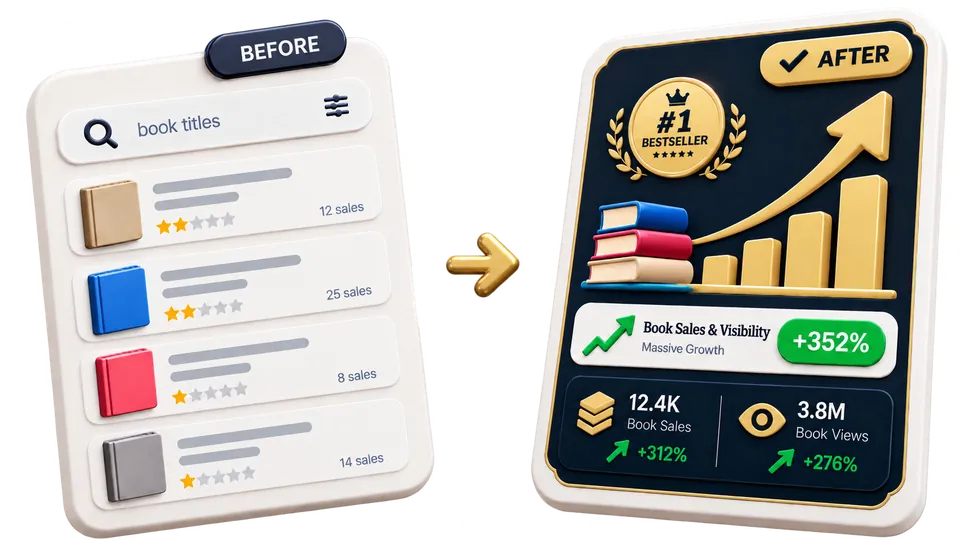
No. Many books find readers months after launch. But restarting needs a plan: a product page that converts, a price that supports advertising, and steady visibility — not a one-day blast.
Common, and usually fixable. Ads amplify what's already there. If the cover, description, reviews or price are weak, ads just pay for people to decide not to buy. The calculator below shows your break-even point.
No. Amazon Ads and BookBub reach readers who are already shopping. A following helps long term, and we help you build an email list you own.
No. Paid or incentivised reviews break Amazon's rules and US and UK consumer law, and 'bestseller guarantees' usually mean a tiny sub-category for a few hours. We use legitimate advance-reader and review-service routes only.
Every genre is different. We recommend the two or three channels that fit your book and budget — not all of them.
Sponsored Products campaigns targeting comparable authors and keywords, tested small and scaled only when the numbers work.
A six-to-eight-week plan: advance reader copies, email, pre-orders and a coordinated launch week.
BookBub Featured Deal submissions and BookBub Ads, plus reputable deal newsletters for price promotions.
A reader magnet, newsletter setup and a simple author website, so you own a direct line to readers.
One book’s marketing journey: the starting point, the campaign we ran, and the results sixteen weeks later.
Literary thriller · E. M. H. · Oregon, US
Six months after launch: a strong book with almost no visibility and ads that lost money.
A salt road. A ringing phone. A town with one secret.
New hook-led description, A+ content and sharper categories.
Keyword and comparable-author campaigns, tested small then scaled.
A $0.99 BookBub Featured Deal stacked with two deal newsletters.
A free prequel short story to build an email list.
Sustained daily sales, a growing list, and ads that pay for themselves.
Small tests first. Scale only what works.
We check cover, description, price, reviews and categories — the things ads can't fix.
Two or three channels chosen for your genre, with a clear monthly budget and goals.
Campaigns go live in your accounts. We test small, cut losers quickly and keep winners.
Monthly plain-English reports: spend, sales, royalties and what we'll change next.
Marketing has two parts: our management fee and your ad budget, which is paid directly to the platform from your own account. We'll recommend a budget that makes sense for your royalty per sale.
Authors are right to be careful — the industry has plenty of companies that over-promise. Here's exactly how we work.
Your KDP, IngramSpark and ACX accounts are created in your name, so royalties are paid straight to you.
You pay in stages tied to work you have seen and approved, never the whole fee up front for large projects.
Copyright, files and ISBNs (when you buy your own) belong to you. You receive editable source files.
Anyone who guarantees bestseller status or sales is guessing. We give you honest forecasts and the reasoning behind them.
A plain-English agreement lists deliverables, revision rounds and dates, so nothing is left to memory.
We are an independent author-services team. We never claim to be Amazon, KDP or any retailer.
“My book sat at zero sales for two months after launch. Within three weeks of starting Amazon Ads I was averaging daily sales and climbing in my category.”
“We got a BookBub Featured Deal on our second submission after they helped me fix my pricing and category strategy. It was the biggest sales day I've had.”
“I had no social presence and dreaded video. The team built a simple content plan that I could keep up with, and it's steadily bringing in readers.”
No — and be wary of anyone who does. Nobody controls what readers buy. We give you honest forecasts, test carefully and report the real results.
Start small — often $10–$20 a day for testing — and only increase when your royalty per sale supports it. The calculator above shows your limits.
Amazon Ads produce useful data in two to four weeks; profitable optimisation usually takes six to twelve weeks. Email and organic channels build more slowly.
We help you get honest reviews the legitimate way: advance reader copies, reputable review services, and asking readers at the back of your book. We never buy or swap reviews.
It can be, especially non-fiction and books with a clear audience. Fiction ads work best with a series, because readers who finish book one buy book two.
You do. Campaigns run in your own Amazon Ads and BookBub accounts, so you see every cent spent.
We'll review your listing and run the ad maths for free — before you spend anything.
Tell us about your book and what you've tried. We'll send a short review and a realistic plan — including when marketing isn't worth it yet.
Prefer to talk it through?
Pick the question closest to your situation. You'll get a straight answer here — and you can take it further with your own AI assistant if you'd like a second opinion.
Still unsure? Ask a real consultant — it's free and there's no obligation.
The click is the ad's job; the sale is the product page's job. Check your cover at thumbnail size, the first lines of your description, your price and your review count.
It depends on your royalty. Break-even ACoS equals your royalty divided by price. With a series, you can often run above break-even on book one and profit on read-through.
A Featured Deal can produce a big spike in sales, but acceptance is selective and it works best with a discounted price and a series behind it. BookBub Ads are more accessible and can be tested small.
Six to eight weeks before launch: build a small email list, send advance copies to early readers and set up pre-orders. Marketing after launch is harder without that momentum.
A simple one, yes — it's where your email list lives and where journalists, podcasts and event organisers look you up.